The Future of Jobs: What Students Should Prepare for Now
Dr. Nikhil Varma
May 10, 2026
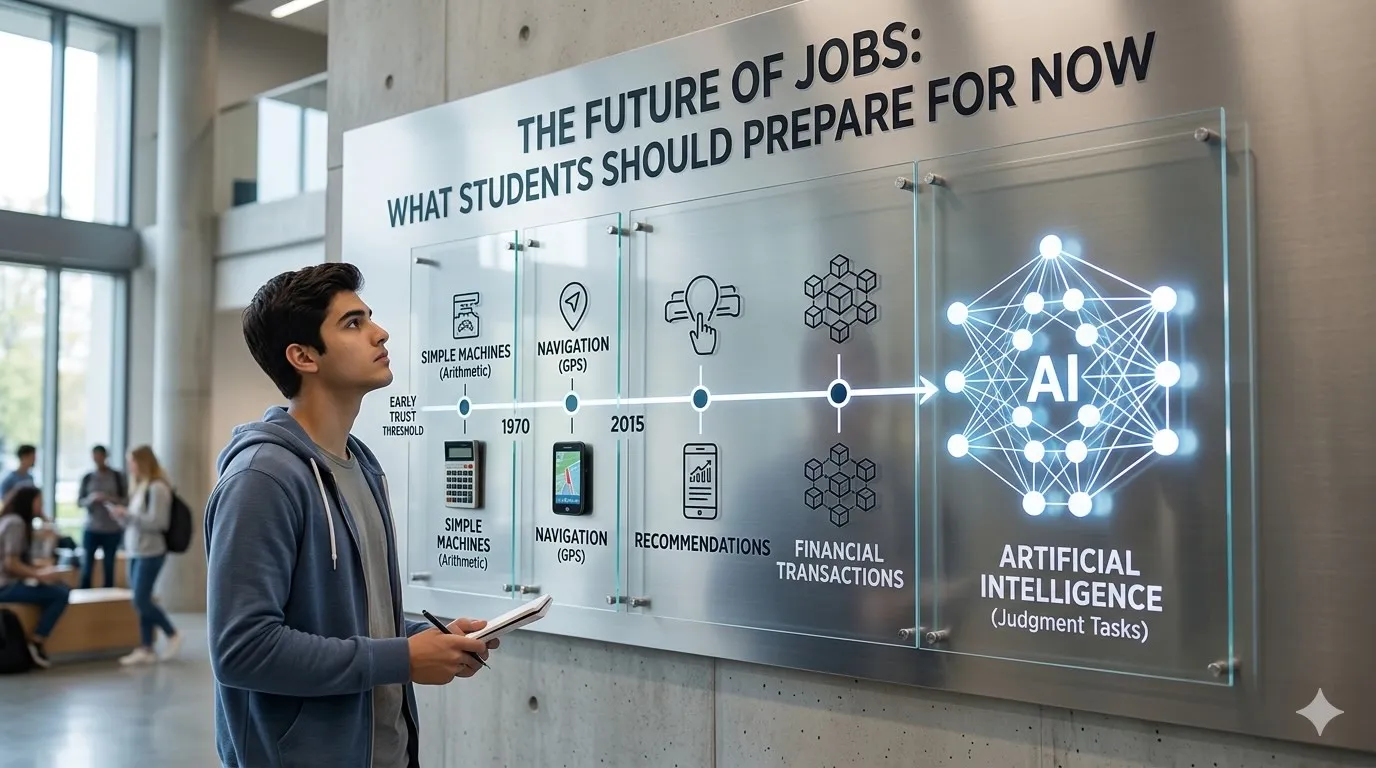
Trust is something we rarely think about until it breaks. When you typed a number into a calculator in school, you trusted it would give you the right answer. When your GPS told you to take the next left, you followed it without verifying the map yourself. When you asked Siri or Alexa a question, you accepted the response without demanding to see the source code.
And now, millions of people use ChatGPT or Gemini to write emails, generate code, and summarize documents, trusting the output with barely a second thought. Every leap in technology has been preceded by a quieter leap in trust.
In my TEDx talk, From Calculators to Smart Contracts, I explored how our relationship with trust has evolved alongside technology. We started by trusting simple machines with arithmetic. Then we trusted them with navigation, with recommendations, with financial transactions, with medical diagnoses, and with legal document review.
Now we are being asked to trust artificial intelligence with tasks that once required years of human judgment. The pattern is clear. Every time we cross a new trust threshold, the nature of work changes. And this time, the change is happening faster than ever before. What took the calculator decades to normalize is happening with AI in months.
The Net Gain and the Skills Gap
The World Economic Forum predicts that by 2030, 170 million new jobs will be created globally while 92 million are displaced, a net gain of 78 million. But that headline number hides a deeper truth:
- Skill Shift: Nearly 40 percent of the skills required for those jobs will be different from what is needed today.
- The Power of Analysis: Seven out of ten employers already say that analytical thinking is the single most important skill their workers need.
- Human Resilience: Resilience, flexibility, and the ability to learn continuously are close behind.
The old model where you studied one subject, mastered one trade, and rode that skill into retirement is no longer viable. One skill for a lifetime was a luxury of a slower era. That era is over.
How Should I Learn to Think?
The question is no longer “what should I study?” but “how should I learn to think?”
The first thing students need to prepare for is a world where their relationship with machines is deeply collaborative. AI will not just be a tool you use occasionally. It will be a coworker, a research assistant, a draft writer, a data analyst, and a decision support system all rolled into one.
But here is the catch. AI is probabilistic, not deterministic. It can be wrong, confidently. It hallucinates. It inherits bias from its training data. This means the human role shifts from doing the work to verifying the work, from producing outputs to exercising judgment over outputs.
Technical Literacy: The New Foundation
Technical literacy is becoming as fundamental as reading and writing. I do not mean that every student needs to become a programmer. But every student needs to understand:
- How algorithms make decisions.
- What data is being collected about them.
- How blockchain creates trust without intermediaries.
- How a large language model generates text.
You do not need to build a car to drive one, but you need to know enough to recognize when the car is malfunctioning. Students who understand the underlying logic of these technologies will be the ones who direct them. Those who do not will be directed by them.
The Intersection of Tech and Human Insight
The fastest growing categories of jobs are not purely technical. They sit at the intersection of technology and human insight. AI ethicists, prompt engineers, blockchain architects, sustainability analysts, digital trust officers.
These roles reward people who can think across disciplines, who can hold a conversation about both code and culture, about algorithms and ethics, about data and dignity. The student who studies only computer science misses the human dimension. The student who studies only philosophy misses the technical one. The student who builds both will be unstoppable.
Critical Thinking: The Essential Survival Tool
The ability to ask the right question, to recognize when an AI generated answer is subtly wrong, to challenge assumptions baked into a model’s training data—this is the single most practical tool a graduate can carry.
When machines handle the computation, the human is left with the harder job of deciding what to compute in the first place and whether the answer actually makes sense.
The students who thrive will be those who develop a portfolio of capabilities:
- Analytical reasoning
- Communication and Empathy
- Adaptability
- Ethical judgment
- Creative problem solving
A Concrete Picture of the Future
In every case, the technical layer has changed, but the human layer has become more important, not less:
- Finance: Needs to understand blockchain-based settlement systems and DeFi protocols.
- Marketing: Needs to understand how generative AI creates personalized content at scale.
- Supply Chain: Needs to understand how IoT sensors and smart contracts create transparent logistics networks.
Building the Capacity to Navigate Uncertainty**
The path forward is about building the capacity to navigate uncertainty itself:
- Learn how to learn. * Develop intellectual humility: The willingness to say “I don’t know” and then go find out.
- Build human networks: Relationships that no algorithm can replicate.
- Stay curious: Read outside your field and ask uncomfortable questions.
The calculator did not make mathematicians obsolete. It freed them to think about higher mathematics. AI will not make thinkers obsolete. It will free them to think about better things. But only if they are prepared.
Dr. Nikhil Varma
Dr. Nikhil Varma is an accomplished academician and industry strategist with over 20 years of experience at the intersection of technology and business management. Currently an Associate Professor of Management at Ramapo College of New Jersey, he specializes in Operations, Blockchain, and Artificial Intelligence, with a multidisciplinary background in Computer Science and Service Design.